Blog · · 3 min read
King Dancer Pose (Naṭarājāsana): The Flexibility You Actually Need
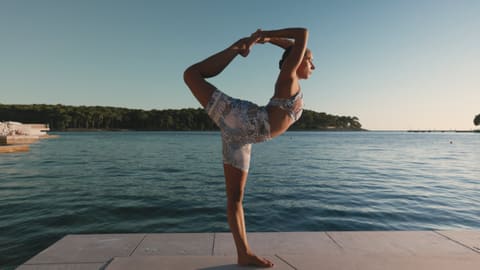
King Dancer is one of the poses I get the most questions about. Naṭarājāsana owes its name to Śiva as the Lord of the Dance: naṭa means dancer and rāja king. It is a dream pose for many, and one that is above all the result of focused preparation.
What you don't need
You don't need a full front split. It will certainly make the pose easier and more beautiful, but if your spine and shoulders are mobile, you can approach the pose effectively without being able to sit in a split.
What you do need: three components
Before you train, ask yourself three questions:
- How flexible are your shoulders in flexion, with the arms overhead?
- How mobile are your hips, in extension (leg behind the torso) and in flexion (leg in front of the torso)?
- How deep and stable is your backbend?
This defines how your Naṭarājāsana looks and how you will feel in it. That is why I created two flows for this pose: one focused on the hips and leg flexibility, and one with preparatory drills for backbends and shoulder flexibility. Your preparation should reflect your strengths and your weaknesses.
Shoulders. Work on shoulder flexion progressively. Start with puppy pose on the mat, at a wall or on blocks, then move on to dolphin pose. After that preparation, you can try poses with a flipped grip: first with a strap, then without.
Backbend. Strong spinal extension is the key. Cobra, bow, camel and wheel all prepare it. Focus on expanding the ribcage and lengthening the spine rather than overarching the lower back. Wheel is especially useful, because it combines shoulder flexion with the backbend.
Hips. The lifted leg needs hip extension, the standing leg a stable hip. For hip extension, practice the long lunge, warrior 3 and low lunges. For hip stability, warrior 3 helps too, as does King Dancer in its simplified form (without the flipped grip).
The part people underestimate: strength
Naṭarājāsana is about static active flexibility. Both glutes work: one stabilizes the standing leg, the other contracts to extend the hip. Both quadriceps engage: on the standing side to keep the alignment, on the working side to extend the knee. Your whole posterior chain has to switch on to support the backbend.
If the pose feels impossible, it may not be range you are missing, but strength in the range you already have.
And balance
The coordination needed to balance on one leg is often overlooked, because the pose demands so much strength and flexibility. Before you try the full bound pose, master its basic, unbound version.
The grip
The flipped grip is its own skill. Learn it somewhere comfortable first: in tiger pose, pigeon, a split, a lunge or sphinx. Use a strap to see how close you are to holding your foot, then try without. Master the grip before you take it into the standing pose.
When you get there: lift the leg high, bend the standing knee slightly, and hold the instep, not just the toes. Flip the grip carefully and reach back with the other hand. If your hands sweat, use chalk, because a strong grip is essential. Then relax the neck, breathe, and deepen gradually by pressing the foot into your hands and extending the arms.
Find balance. Let go of the panic and find peace in the pose.
The whole path, step by step and with photos, is in my free Naṭarājāsana progression.
If you want to practice it as one guided flow, the Naṭarājāsana Krama Vinyāsa class in the online community takes you from breathwork to the flipped grip in a single session.