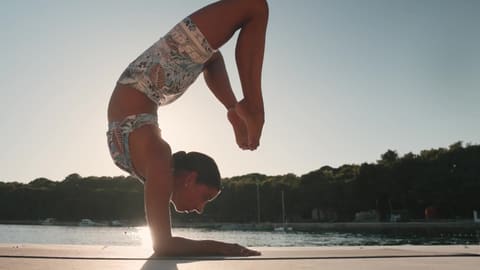
Online masterclass · Skool
Forearm Stand Masterclass: Learn Piñcha Mayūrāsana Step by Step
From your first dolphin pose to a steady, free-standing forearm stand, with safe bailouts and personal video feedback.
The masterclass is part of the Sofia Balance Method community on Skool.
Why forearm stand feels impossible (and why it isn't)
Most people kick up, fall, kick up again and hope it clicks. It rarely does. Forearm stand needs shoulder flexibility and stability, awareness of your center of gravity and a nervous system that feels safe upside down. If one of these is missing, no amount of kicking will fix it.
The masterclass breaks Piñcha Mayūrāsana into those components, trains each one in the right order and then puts them back together.
What you'll learn
Shoulder preparation
Exercises for shoulder flexibility and strength.
Fear management
How to work with the fear of falling instead of fighting it.
Safe bailouts
Practice coming out of the pose safely in every direction before you start balancing.
Entries
Different ways into the pose, from controlled leg lifts to more advanced entries.
Shape variations
Stag, V-shape and straight line, and what each one teaches your balance.
Course curriculum
The masterclass has two parts and more than 30 video lessons. Go through them at your own pace. You don't need to finish everything in one day.
Part 1
Foundations, safe bails and your first free balance
- Shoulder warm-up
- Forearm plank to half Piñcha (dolphin pose)
- Hip flexor strengthening drills
- Half headstand to half Piñcha
- L-sit preparation
- Wall climbs, chest to wall, for a clean straight-line alignment
- Safe bails: elbow lift, falling over and head drop
- Wall drills: bringing the legs together, V-shape, stag chest to wall
- Balancing in stag in the middle of the room
- Practice plan
Part 2
Alignment, entries and straight Piñcha
- Forearm placement
- Block drills and leg engagement
- Headstand socks drills (knees and hips)
- Rebalancing, against the wall and freestanding
- Back-to-wall straight Piñcha and stag drill
- Kick-up, leg switch and kick-up to V-shape
- Balancing straight Piñcha in the middle of the room
- Full-length follow-along video
Why safe bails come first
Learning how to fall is crucial when you learn Piñcha. It always feels scary at first, but the body has its own mechanisms to protect itself. The bail lessons teach you to become aware of those mechanisms and use them consciously.
Follow-along practice
Once you know the drills, the Piñcha & Split Vinyāsa class from the advanced course puts them into a full flow, with entries like press up, push off, kick up and press from the block, and shapes from straight to stag, double stag and split.
Who this masterclass is for
- Practitioners who can hold dolphin pose and want their first forearm stand
- Yoga teachers who want to teach Piñcha with confidence and correct cues
- Dancers, aerialists and athletes who want a stable inversion base
- Anyone who has been stuck at the wall for months
Before you start
You don't need to be strong or flexible already. You should be free of acute shoulder, neck or wrist injuries. If you have any, mention them when you post your first clip, and Sofia will adapt your progression.
In September 2023 my only goal was to balance in a forearm stand.
Frequently asked questions
What is Piñcha Mayūrāsana?
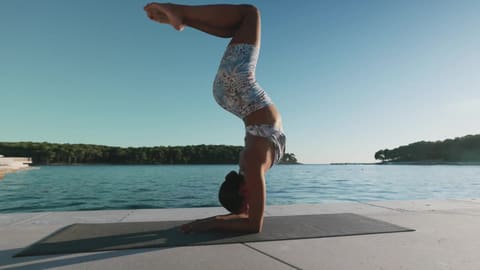
Piñcha Mayūrāsana is the Sanskrit name for forearm stand, often translated as “feathered peacock pose”. You balance upside down on your forearms, with the legs extended up like the raised tail feathers of a peacock.
How long does it take to learn forearm stand?
It depends on your shoulder flexibility, strength and how often you practice. Some students balance within weeks, others need a few months. The masterclass shows you which part to train first so you don't waste time.
Is forearm stand easier than handstand?
For many people it feels more stable, because the base is larger and closer to the floor. It demands more shoulder flexibility, though, especially for keeping the chest open and the elbows in line.
Should I practice against the wall?
The wall is useful for building strength and shoulder alignment. The masterclass shows you when to use it and how to leave it, so it doesn't become a habit you can't break.
Can I learn forearm stand at home?
Yes. All you need is a mat, some space and, for the early stages, a wall. Personal video feedback replaces the corrections you'd get in the studio.
Ready for your first forearm stand?
Start the masterclass in the Sofia Balance Method community, or apply for private coaching if you'd like one-on-one guidance.