Class library · Advanced
King Dancer Pose (Naṭarājāsana): A Progression to the Flipped Grip
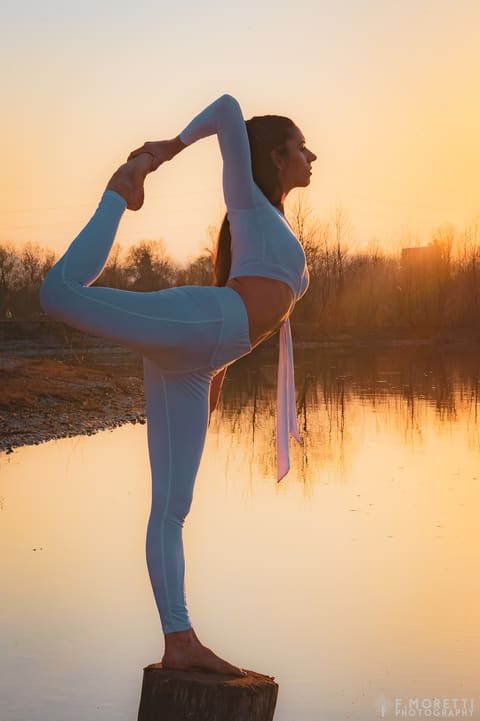
This advanced flow guides you through a detailed progression toward full King Dancer Pose, focusing on the deep hip extension, shoulder flexibility and flipped-grip transitions this peak pose requires.
- Level
- Advanced
- Length
- 66 / 79 min
- Props
- Two blocks, a strap, liquid chalk
Props
Two yoga blocks and a strap. Liquid chalk is recommended if your palms sweat during heavy grip work.
Breathwork
The class begins with breathwork to stretch the muscles of the ribcage and build awareness of Uḍḍīyāna and Mūla Bandha. Equal-ratio Ujjāyī breath (box breathing in counts of 4, 6 and 8) is followed by two rounds of Kapālabhāti (108 exhales) with breath retention, to prepare the nervous system and the core for deep backbending.
What's included
- Warm-up and shoulder mobility: tabletop variations, Cat-Cow, Puppy Pose (including elevated block and extended variations) and spinal twists
- Backbend and hip preparation: Sphinx and Cobra with hamstring and glute activation, Bow Pose, Gate Pose (Parighāsana) and Tiger Pose progressions
- Sun Salutations: heart-opening backbends, interlaced-finger variations and Chaturaṅga flows
- Standing and peak sequence: High Lunge, Warrior 3, Standing Split, Lizard and Revolved Lizard, Kapyāsana with Kālī Mudrā, Baddha Añjaneyāsana and strap-assisted flipped grips
- Hanumānāsana and split krama: deep split progressions with blocks, vertical shin tests to check internal hip rotation, Mermaid Pose and Eka Pāda Rājakapotāsana IV variations
- Peak practice: Tiger Pose flipped-grip work leading into King Dancer, with a strap, liquid chalk and full hand-to-foot flipped grips
- Cool-down and Śavāsana: forward folds, Paścimottānāsana, Tārāsana side bends, Shoulder Stand (Sālamba Sarvāṅgāsana), Halāsana, supine twists and a five-minute Śavāsana
The class comes in two versions: a shorter one focused on the hips, and a full one that adds backbend conditioning.
Who it's for, and precautions
This is an advanced flow that requires a high level of āsana practice, flexibility and body awareness. It is not suitable for beginners, intermediate practitioners, or anyone working through active shoulder, spinal or hamstring injuries.
Approach backbends with care. Never force a flipped grip: let your breath and alignment guide your depth, and back off immediately if you feel sharp pain or lose smooth control of your breath.
What to expect
Balancing at your maximum range of motion is naturally unstable. Wobbling, falling or needing several attempts is a normal part of the process. Focus on grace in your transitions, keep your ego out of the depth, and use rebound movements like spinal waves and gentle twists to support your spine as you build consistency over time.