Blog · · 3 min read
How Long Does It Take to Get the Splits? An Honest Answer
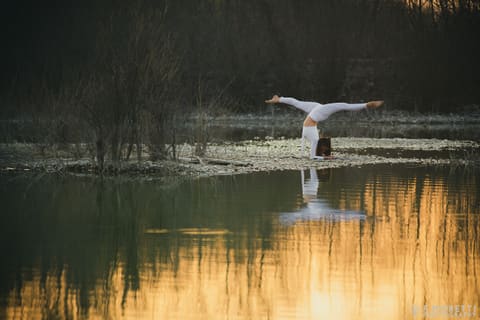
It's the question I hear most, usually in the very first message: how long until I get my splits? The honest answer is that nobody can tell you before seeing you move. Anyone who promises a full split in 30 days without knowing your body is guessing.
What I can tell you is what decides the timeline, and why so many people stretch for years without getting any closer.
What decides your timeline
Where you start. Some people are a few centimeters from the floor, others considerably further.
What is actually holding you back. A front split stretches the hamstrings of the front leg and the hip flexors and quadriceps of the back leg. For most people one of these is the bigger brake. Depending on which it is, the approach and focus of your training should differ.
Your training history and age. Dancers often start with more range. Athletes, like the boxer you'll meet below, sometimes start with less. Age plays a part too, but none of these decides on its own.
Consistency. Flexibility is the result of regular work, not of one heroic session a month. Two or three sessions a week, done every week, will take you further than a long stretch whenever you remember.
How long it has taken my clients
One of my clients, a pole dance instructor, reached her full splits in three months, after years of trying and giving up out of frustration. Another, a national boxing champion for whom flexibility had always been a weak point, can do a front split, a headstand and crow pose after four months of consistent work. One yoga teacher needed just a month. Others have needed anywhere from a few months to longer, and that is a normal timeframe.
What they had in common wasn't talent. It was a plan, and showing up for it.
Why years of stretching often go nowhere
No structure. The same stretches at the end of a class, or whatever the group class happens to do that day. No repetition, no holding of poses. In a group, the teacher adapts to the average, and your split rarely gets the attention it needs.
Passive stretching. A split isn't only a stretch. In my progressions I ask you to keep both quadriceps active, squeeze the glute of the back leg and draw in the lower belly. Passive flexibility matters, but in practice it is active flexibility that lets you apply your passive flexibility in your discipline.
Holding the breath. Many people fight the stretch and stop breathing. Breathing inside the posture is part of the method: it is how you learn to stay in the pose, relax and go a little deeper. The pole dance instructor I mentioned says she finally learned to enjoy the feeling of stretching through proper breathing.
Not enough intensity. Flexibility doesn't progress if you never work at the limit of your range of motion. I often remind my clients to give their best in every session, even if on some days their best is less. With control, of course, never by force.
What speeds it up
Private coaching starts with an assessment. I test your range of motion, strength and coordination to find the real limiting factor, and only then build the program. It follows Krama Vinyāsa, intelligent sequencing in which every movement prepares the body for the peak pose, so the split is the logical end of the session, not a fight at the start of it.
If you'd like to begin on your own, start with my free front split progression: nine steps from a lunge to the full Hanumānāsana. Hold each pose for at least 30 seconds, ideally longer. Repeat the sequence two or three times in a session, and do the routine two or three times a week, consistently.
When you are ready for a full guided practice, Front Split Vinyāsa in the online community combines ballet conditioning with a yogic sequence, built to be practiced three times a week.